Pollen Control in Hemp Production in New Zealand
This document outlines key risks and related best practiceassociated with pollen control in hemp (Cannabis sativa L.) production in New Zealand, aligned with transitioning regulatory settings (May 28, 2026 onwards).

Regulatory Context in New Zealand

May 28, 2026

New Zealand has recently modernised its hemp regulatory framework. Cabinet-approved reforms remove routine licensing requirements for hemp, increase the allowable THC threshold to less than 1 percent, and permit the supply of Hemp plant material (including flowers and leaves) to licensed Medicinal Cannabis producers. Growers must notify the New Zealand Police and the Ministry for Primary Industries (MPI) before planting, and all applicable Food Safety, Agricultural Compounds and Veterinary Medicines (ACVM), and Medicinal cannabis scheme requirements continue to apply.

Further information can be found:

Misuse of Drugs Amendment Regulations 2026 | New Zealand Legislation

New Zealand Police

Ministry for Primary Industries: Hemp guidance for growers, processors, importers and exporters

Ministry of Health Hemp Guidelines

New Zealand Food Safety ACVM Hemp Alert

While pollen control is not explicitly prescribed in regulation, growers are responsible for ensuring their activities do not cause downstream compliance issues, commercial harm, or genetic contamination.

Why Pollen Control Matters

Hemp is a wind-pollinated species and male plants produce very large quantities of pollen during flowering.  Hemp pollen has been reported to be able to travel more than 10km in the right conditions, and New Zealand’s open arable landscapes, particularly in regions such as Canterbury and Hawke’s Bay, are very amenable to this.  

Unwanted pollen drift may affect neighbouring hemp crops, medicinal cannabis operations, breeding programmes, seed multiplication crops, and growers attempting to maintain stable genetics.  

Unmanaged pollen can result in seeded flower crops, reduced cannabinoid yield (2-3x reduction potential), contamination of neighbouring hemp crops, compromised seed integrity and genetic purity, loss of seed certification following harvest, and long-term THC compliance risks through contaminated seed progeny (unstable cannabinoid levels including THC).

The above risks may lead to commercial disputes, rejected contracts, and potentially legal action for lost revenue between growers, if responsible pollen management is not undertaken.

Best Practice for Pollen Control

Spatial Separation and Crop Layout

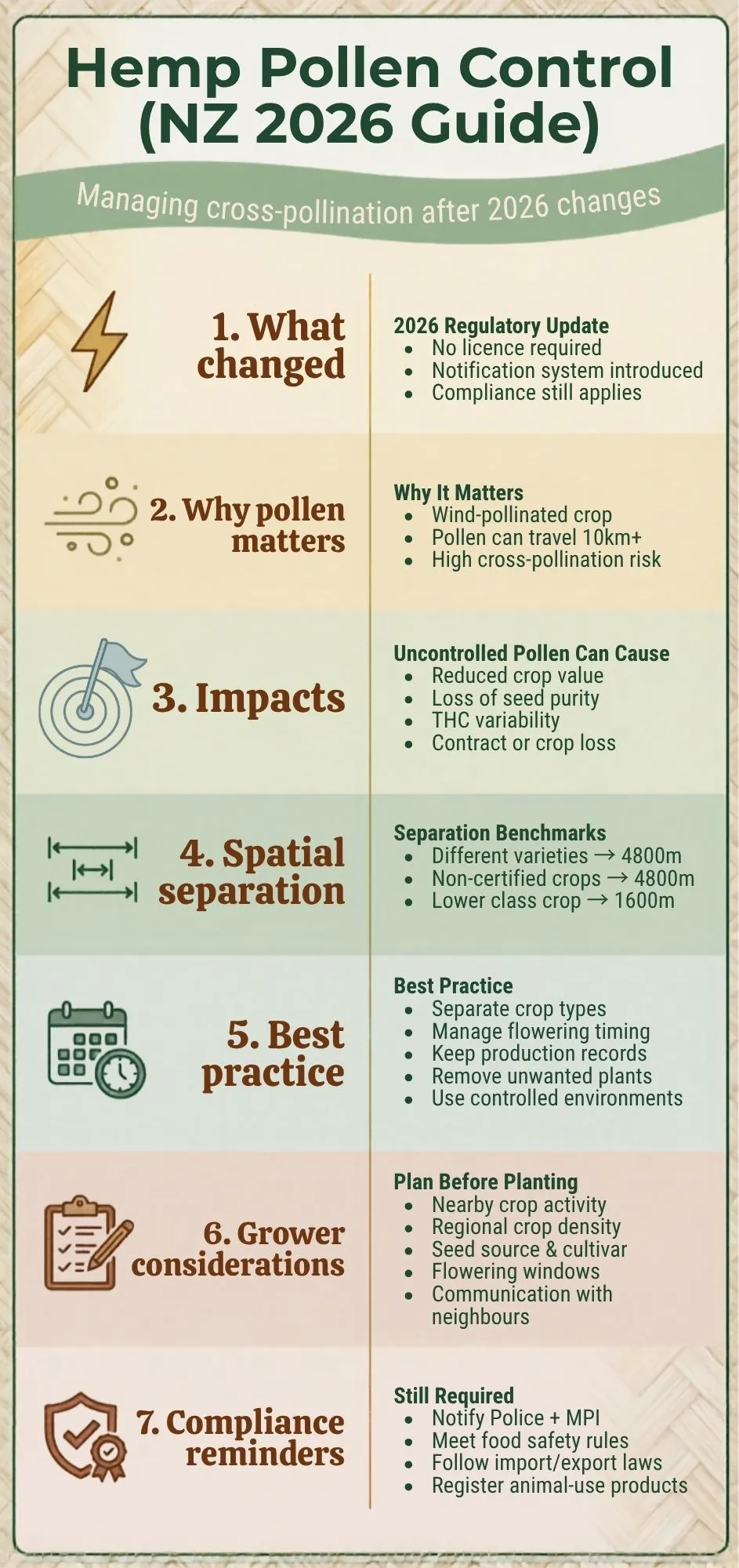
Although no statutory isolation distances are set in New Zealand regulations, growers should maximise separation between pollen-producing crops (e.g. fibre or seed hemp), and between pollen-producing crops and flower crops (female plants only).  Seed production, particularly certified or proprietary lines, demands the strictest cross-pollination controls. OECD seed certification standards as an example require 4800m spatial separation for higher generation seed production (Table 1.) to stop cross pollination occurring.   Growers therefore need to avoid planting hemp near other hemp or medicinal cannabis sites, and coordinate planting and flowering periods with neighbouring growers where possible.

Table 1: Isolation Distances from OECD seed certification scheme for Dioecious varieties of Industrial Hemp.
Indicative isolation distances for dioecious industrial hemp seed production
To produce class Other crops Isolation distance
Breeders / Foundation i) Different varieties of industrial hemp 4800m
ii) Non-certified crops of same kind 4800m
iii) Lower certified class seed crop of same variety 2000m
iv) Same variety and class of certified seed 5m
Basic / Registered i) Different varieties of industrial hemp 4800m
ii) Non-certified crops of same kind 4800m
iii) Lower certified class seed crop of same variety 1600m
iv) Same variety and class of certified seed 1m
1st Generation / Certified i) Different varieties of industrial hemp 800m
2nd Generation ii) Non-certified crops of same kind 800m
iii) Lower certified class seed crop of same variety 200m
iv) Same variety and class of certified seed 1m

These distances are indicative reference values for seed production planning and cross-pollination risk management.

Notification and Record-Keeping

Growers must notify Police and MPI of crop locations before planting. Robust records should also be maintained, including cultivar details, intended end use, and flowering windows.  Documentation of pollen management practices helps demonstrate due diligence.  Growers will ideally also communicate with reputable seed suppliers and industry groups on matters relating to Pollen control, while still protecting privacy and commercial IP.

Controlled Environments and Breeding

For breeding, seed production, or high-value flower production systems, physical isolation and controlled airflow albeit at a higher cost (such as greenhouse separation and filtration), are strongly recommended to prevent cross-pollination.

Further Grower Responsibilities

When deciding to plant hemp outdoors for any end use, agrower should consider the following steps relating to Pollen control.

  1. Consider the history and geography of the region the grower intends to plant in, to determine if your crop is a risk to your neighbours and other local growers. For example, high density of certified seed production in Canterbury, Medicinal Cannabis production in Marlborough etc.  
  2. Where possible, develop an understanding of regional growing activity in your local area, and the related pollination risks.
  3. If you are growing for seed, grain or fibre, make contact with the NZHIA who will then be able to advise on any potential pollen risks and who to contact in order to mitigate these risks, depending on your intended production location and type of crop.
  4. Purchase your Hemp seed for sowing from a reputable supplier, who will also be able to assist with the identification of potential pollen risks for your intended production location and type of crop.
  5. Ensure you are planting a recognised cultivar with a clearly defined flowering window, and where possible purchase Certified sowing seed.
  6. Ensure you are planting a compliant low THC (<1% THC) cultivar so no downstream compliance issues are raised.
  7. Communicate with neighbouring growers where practical, including your understanding of the flowering timing of your hemp crop.
  8. Rogue adjacent areas to your hemp crop for any volunteer hemp plants from previous productions.
  9. Ensure fibre crops are cut prior to pollen shed.
  10. Ensure flower crops (female only plants) are rogued for male plants and volunteer plants within the crop.
  11. Support a professional, respectful, and collaborative industry culture, to help manage pollen control.

Summary

Under New Zealand’s reformed hemp regulatory framework,pollen control is a critical element of responsible crop management.  Best practice relies on appropriate genetics,spatial planning, intensive monitoring, and clear communication with regulatorsand neighbouring growers.  Effectivepollen management protects crop value, regulatory compliance, and the long-termcredibility of the New Zealand hemp industry.

Key Industry Contacts

For Growing Biomass (leaves & flowers)

New Zealand Medicinal Cannabis Council

Growing for Seed, Grain or Fibre

New Zealand Hemp Industries Association

Purchasing Hemp Seed for Sowing

Midlands Seed

New Zealand Police

Notification Form

Minsitry of Primary Industries

How to Notify MPI

Contact us

Thank you! Your submission has been received!
Oops! Something went wrong while submitting the form.